
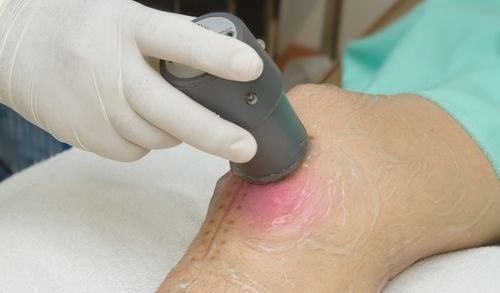
Ultrasound Therapy

Ultrasound therapy uses high-frequency sound waves far beyond those that are distinguishable to human hearing. These high-frequency sound waves can be used to help in the treatment and healing of wounds and injuries. Ultrasound therapy can reduce inflammation, improve healing and relieve pain in cases of soft tissue damage such as that of muscles, tendons, fascia, bursas (joint cushions).

Uses

The dosage of intensity and frequency for ultrasound therapy varies depending on each case, but it’s mainly used as part of a physical therapy program especially in the following cases:

  • Contracture of muscle, tendon and fascia; which is the abnormal shortening and loss of elasticity, such as with plantar fasciitis
  • In cases of chronic lower back pain, when there is no apparent physical cause
  • Coccydynia, which is pain in the tailbone area of unknown origin
  • In cases of sports injuries and muscle strains, sprain or spasm
  • Inflammatory diseases of the joints, tendons and bone, such as osteoarthritis, rheumatoid arthritis tendonitis or bursitis; as it increases the blood flow and collagen formation (the main protein component of soft tissue)
  • Increasing the extensibility of mature collagen, as that of the already formed fibrous tissue in scars and previously injured tissue

The Procedure

Ultrasound therapy itself is a simple and quick procedure that lasts from a few minutes to less than an hour. It can be performed once or more per day depending on the purpose of therapy. During the procedure, the affected area is massaged with an ultrasound probe that has been covered with a conducting gel to increase the efficiency of the procedure.

Ultrasound therapy works by two mechanisms: thermal and mechanical. The thermal mechanism of ultrasound therapy uses a more continuous pattern of sound waves to penetrate deep into the tissue, causing microscopic vibrations. This raises the temperature of the treated area, making the tissue warmer, and increasing the blood flow and metabolic rate of that tissue. Mechanical ultrasound therapy uses sound wave pulses that penetrate more deeply, causing the small bubbles in the soft tissue to expand and contract; which reduces the swelling and inflammation of the tissue, thus reducing the pain.

Advantages

Ultrasound therapy is an inexpensive, simple and non-invasive procedure. It does not require an operation and it will not leave a scar or expose a patient to radiation. It is easy to apply in a clinic setting or at home. Ultrasound therapy can be performed by a trained professional or by the patient, with appropriate instruction and training. Ultrasound therapy has been shown to be very effective in resolving inflammation and reducing pain, while promoting more rapid healing.

Precautions

As safe and easy as ultrasound therapy is, it can cause severe damage when applied to the wrong tissue or used inappropriately. Therefore, the following guidelines and contraindications should be noted:

  • It is contraindicated to the eyes and eye area, genital area (especially in males), abdominal area, the site of recent spinal surgery or exposed neural tissue, because of the damage it may cause to these sensitive areas.
  • Ultrasound therapy should be avoided in cases of acute infections, cancers and malignancies, as it can help spread the infection or tumor.
  • It is contraindicated in cases of thromboembolic disease because of the risk of dislodging a blood clot.
  • Patients with pacemakers should avoid ultrasound therapy as it can interfere with the performance of the device. Ultrasound should generally be avoided by patients who have metal implants, as the increased heat of the metal can cause burning damage to the surrounding tissue.

Recovery

Recovery with ultrasound therapy depends greatly on the professional providing the treatment, because application of the correct intensity and frequency is crucial. Ultrasound therapy is typically part of a more comprehensive treatment plan of physical therapy that also includes proper massage and exercise. These therapies can be crucial to healing and recovery.

Related Articles

Skin Substitutes

Skin substitutes as a form of wound closure have been found useful since the earliest centuries of medical science. Skin is made up of epidermis (uppe...

Biatain Foam

Biatain foam was introduced as early as the 1970s. Biatain foam is a soft, pliable dressing which is comprised of an outer layer that helps guard agai...

Biologic Debridement

Biologic debridement is the use of living organisms to remove necrotic or dead tissue from a wound. The most commonly used biologic debridement method...

Topical Wound Treatments

When it comes to wound care, the challenge is to strike a balance between keeping the wound clean and moist, while at the same time fighting off the b...

Advanced Dressings

Biatain Foam Biatain foam is a soft, pliable dressing which is comprised of an outer layer that helps guard against bacteria and infection, and an in...

Growth Factor Therapy

Growth factor therapy is the use of growth factors to promote wound healing. Growth factors are substances secreted by the body whose function is to s...

Vacuum-Assisted Closure

Vacuum-assisted closure (VAC) is a sophisticated development of a standard surgical procedure—the use of vacuum-assisted drainage to remove bloo...

Nutritional Support for Wound Healing

Nutritional support for wound healing can greatly affect the three stages of the process: the inflammatory, proliferative, and remodeling phases. Poor...

Electromyography

Electromyography (EMG) is a diagnostic test that measures the health and function of the muscles and the nerves which controls these muscles.  H...

Nerve Studies

Nerve studies are also known as nerve conduction studies. These studies measure how well nerves send signals through the body. Uses This procedure i...

Compression Stockings

Compression stockings or socks are special stockings used for the treatment of venous diseases such as varicose veins. These stockings can exert press...

Vascular Studies

Vascular studies measure and assess the amount of circulation within the blood vessels. Uses This noninvasive procedure is used as a tool in the tre...

Total Contact Casting

Total contact casting is a method used to treat diabetic foot ulcers by fitting a non-removable cast around the affected leg. The whole cast is in con...

Hyperbaric Oxygen Treatment

Hyperbaric oxygen treatment, or hyperbaric oxygen therapy (HBOT), involves breathing 100 percent oxygen at increased atmospheric pressures to increase...

Low Level Laser Therapy

Low level laser therapy (LLLT) is a medical procedure used to treat pain and speed up wound healing. This treatment uses low-level lasers to alte...

Ultraviolet Light Therapy

Ultraviolet (UV) light therapy has been used for centuries to help in the treatment of many skin conditions, disorders and diseases. While exposure to...

At Home Wound Treatment

Applying first aid as initial medical care to a wound or an injury temporarily until a professional medical care is available can, in many cases, be l...

Negative Pressure Wound Therapy

Negative pressure wound therapy is a medical procedure in which a vacuum dressing is used to enhance and promote wound healing in acute, chronic and b...

Wound Closure

Whether they are caused by surgery or injury, wounds generally must be closed for proper healing. Wound closure is typically done with sutures (stitch...

Sutures, Stitches, and Staples

Sutures, stitches and staples are used for the same purpose - to close wounds or surgical incisions - but they are not the same. For sutures, doctors ...

Nerve Conduction Study (NCS)

A nerve conduction study (NCS) is used to determine electrical conduction within motor and sensory nerves, essentially determining the functionality o...

Sharp Debridement

Sharp debridement is a surgical procedure that uses scissors, scalpels and other sharp instruments to cut away or remove infected tissue. It improves ...

Antibiotics

Topical Antibiotics Antibiotics are often prescribed to treat an infection topically. This means that you will apply antibiotic creams, ointments or ...
Find a Treatment Center
List Your Facility
Be found by clients looking for your exact skills. Learn more.